学习 Http Protocol
HTTP is an application-level protocol for distributed, collaborative, hypermedia information systems, while * TCP* solves the logic of the transport layer. The reason why HTTP uses TCP instead of UDP is that ( open) a web page must transfer a lot of data, and the TCP protocol provides transmission control, organizes data in order, and error correction.
The HTTPconnection uses the “request-response” method, which not only needs to establish a connection when requesting, but also the server can only reply to the data after the client sends a request to the server.
HTTP/1.0 is the first HTTP protocol version to specify the version number in the communication, and it is still widely used, especially in proxy servers.
Persistent connections are used by default in HTTP/1.1, and it can work well with proxy servers. It also supports sending multiple requests at the same time in pipeline mode to reduce line load and improve transmission speed.
HTTP/2.0 greatly improves web performance on the basis of HTTP/1.x and reduces network latency. HTTP/1.0 and 1.1 will coexist for a long time in the future, which is determined by the slow update of network infrastructure.
HTTP/0.9
The initial version of HTTP had no version number (it was later called 0.9 to differentiate it from later versions)
HTTP/0.9 was extremely simple:
- Requests consisted of a single line and started with the only possible method
GETfollowed by the path to the resource. - The full URL wasn’t included as the protocol, server, and port weren’t necessary once connected to the server.
GET /example.htmlAnd the server will close the TCP connection once it has sent the response.
<html>
example page content
</html>HTTP/1.0
HTTP/1.0 is not a standard. It is just a reference document that records existing practices and patterns. It has no actual binding force.
With the development of the Internet, the original HTTP (HTTP/0.9) can no longer meet user needs.
HTTP/1.0 was launched in 1996 (Between 1991-1995, these were introduced with a try-and-see approach. an informational document that described the common practices was published in 1996. This was known as RFC 1945 and defined HTTP/1.0)
- Versioning information was sent within each request (HTTP/1.0 was appended to the
GETline). - A status code line was also sent at the beginning of a response. This allowed the browser itself to recognize the success or failure of a request and adapt its behavior accordingly. For example, updating or using its local cache in a specific way.
- The concept of HTTP
headerswas introduced for both requests and responses. Metadata could be transmitted and the protocol became extremely flexible and extensible. - Documents other than plain HTML files could be transmitted thanks to the
Content-Typeheader.
Example 1. Plain Text
- Request
GET /mypage.html HTTP/1.0
User-Agent: NCSA_Mosaic/2.0 (Windows 3.1)- Response
200 OK
Date: Tue, 15 Nov 1994 08:12:31 GMT
Server: CERN/3.0 libwww/2.17
Content-Type: text/html
<HTML>
A page with an image
<IMG SRC="/myimage.gif">
</HTML>Example 2. Image
- Request
GET /myimage.gif HTTP/1.0
User-Agent: NCSA_Mosaic/2.0 (Windows 3.1)- Response
200 OK
Date: Tue, 15 Nov 1994 08:12:32 GMT
Server: CERN/3.0 libwww/2.17
Content-Type: text/gif
(image content)HTTP/1.1
The first standardized version of HTTP, HTTP/1.1, was published in early 1997, only a few months after * HTTP/1.0*.
- New methods were added (
PUT,DELETE,TRACE,OPTIONS,CONNECT, etc.) - A TCP connection could be reused, which saved time. It no longer needed to be opened multiple times to display the
resources embedded in the single original document. (By specifying the
Connection: keep-aliveheader) - Pipelining was added. This allowed a second request to be sent before the answer to the first one was fully transmitted. This lowered the latency of the communication.
- Chunked responses were also supported, largely improving the way large files were sent.
- Additional cache control mechanisms were introduced (such as
Cache-Control,ETag,If-Modified-Since,If-Unmodified-Since,If-Match,If-None-Match, etc.) - Thanks to the
Hostheader, the ability to host different domains from the same IP address allowed server collocation. (TheHostheader is required in HTTP/1.1)
HTTP/2.0
Google implemented an experimental protocol SPDY in the early 2010s. SPDY defined an increase in responsiveness
and solved the problem of duplicate data transmission, serving as the foundation for the HTTP/2 protocol.
The HTTP/2 protocol differs from HTTP/1.1 in a few ways:
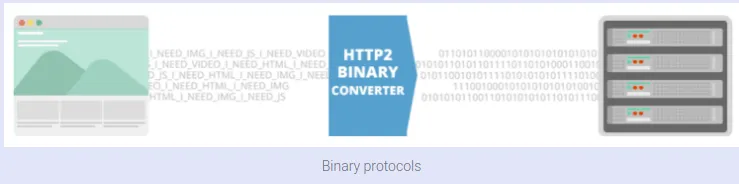
- It’s a binary protocol rather than a text protocol. It transfers binary instead of plain text.
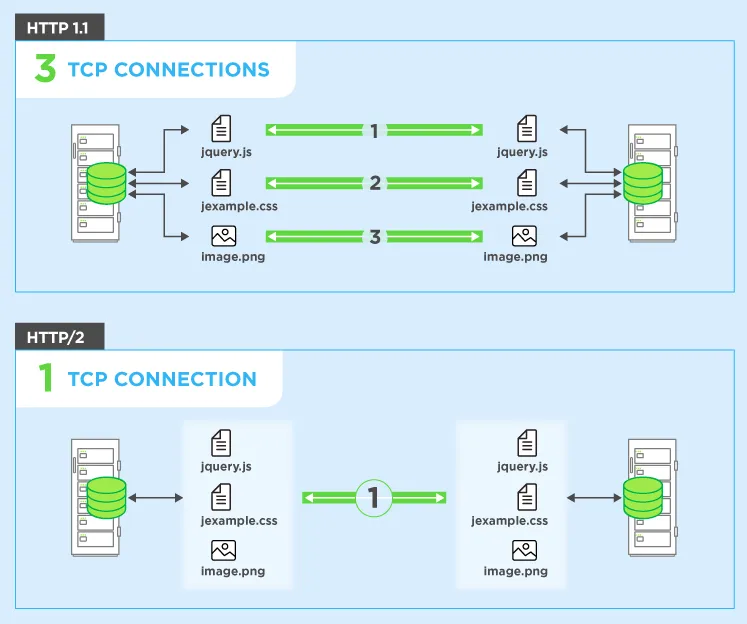
- It’s a multiplexed protocol. Parallel requests can be made over the same tcp connection, removing the constraints of the HTTP/1.x protocol.
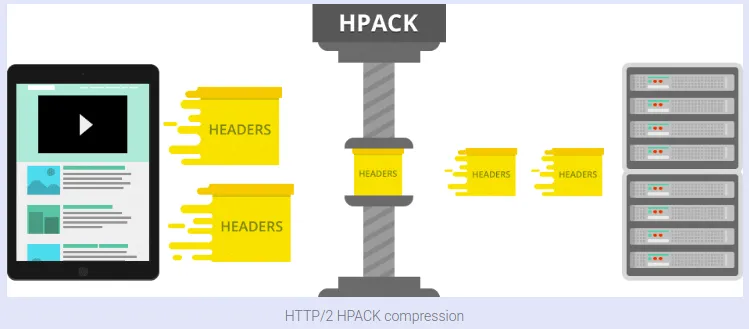
- It compresses headers using the HPACK compression algorithm. As these are often similar among a set of requests, this removes the duplication and overhead of data transmitted.
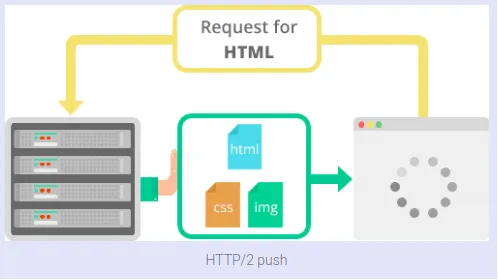
- It allows a server to populate data in a client cache through a mechanism called the server push.
Server Push
Imagine that the guest (Client) asks (sends request) waiter (Server) for a meal, then the waiter gets the meal from the restaurant chef (your application logic), but the waiter also thinks you would need a bottle of water, so he brings that too with your meal. The end result of this would be only one TCP connection and only one request that will significantly lower the server load.
HTTP/3.0
Google invented the QUIC(Quick UDP Internet Connections) protocol based on UDP.
QUIC is designed to provide much lower latency for HTTP connections. Like HTTP/2, it is a multiplexed protocol, but HTTP/2 runs over a single TCP connection, so packet loss detection and retransmission handled at the TCP layer can block all streams. QUIC runs multiple streams over UDP and implements packet loss detection and retransmission independently for each stream, so that if an error occurs, only the stream with data in that packet is blocked.
- UDP is
unordered, so there is no head-of-line blocking problem - QUIC has its own protocol for packet loss retransmission and congestion control
- The HTTPS handshake usually requires six network interactions. QUIC merges TLS and TCP into a three-way handshake.
In June 2022, HTTP/3.0 was finally standardized as rfc9114
Diagram
Request Multiplexing
Header Compression
Binary Protocol
Server Push
Simple Comparison
| Protocol | Number of requests | Load time | Initiator |
|---|---|---|---|
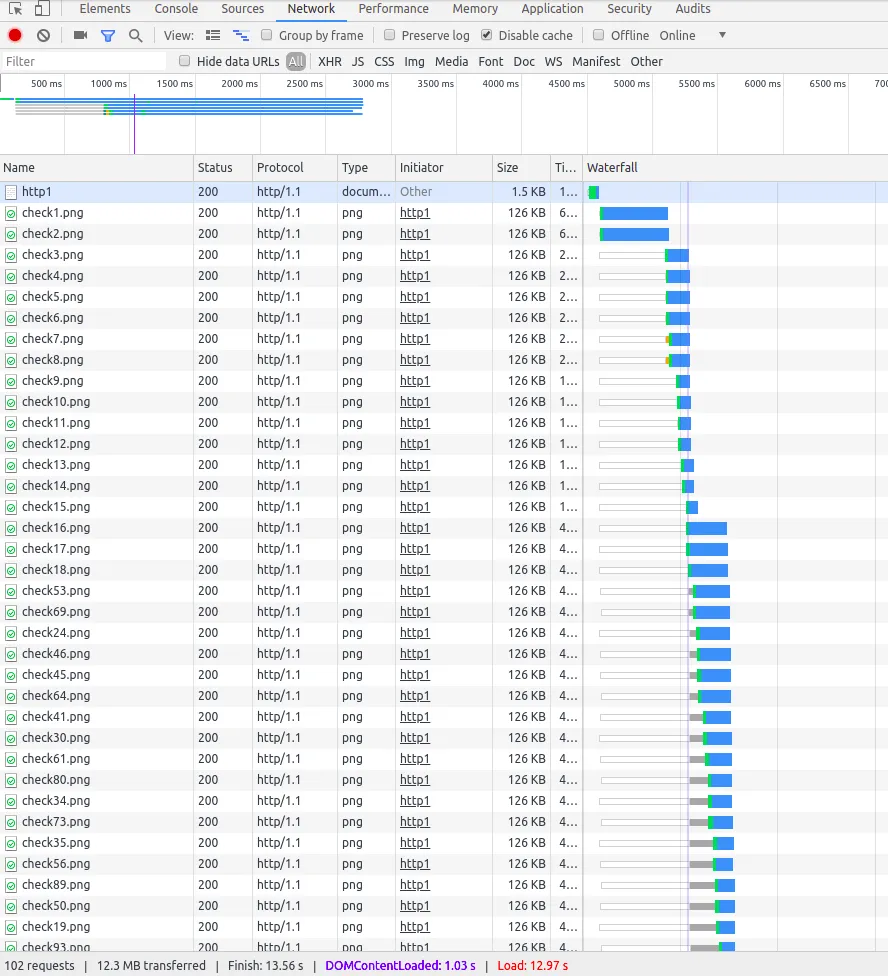
| Http/1.1 | 102 | 12.97s | Initiator of the first one is user/client and the rest of the requests are initiated by the response to client who realizes he needs some other resources |
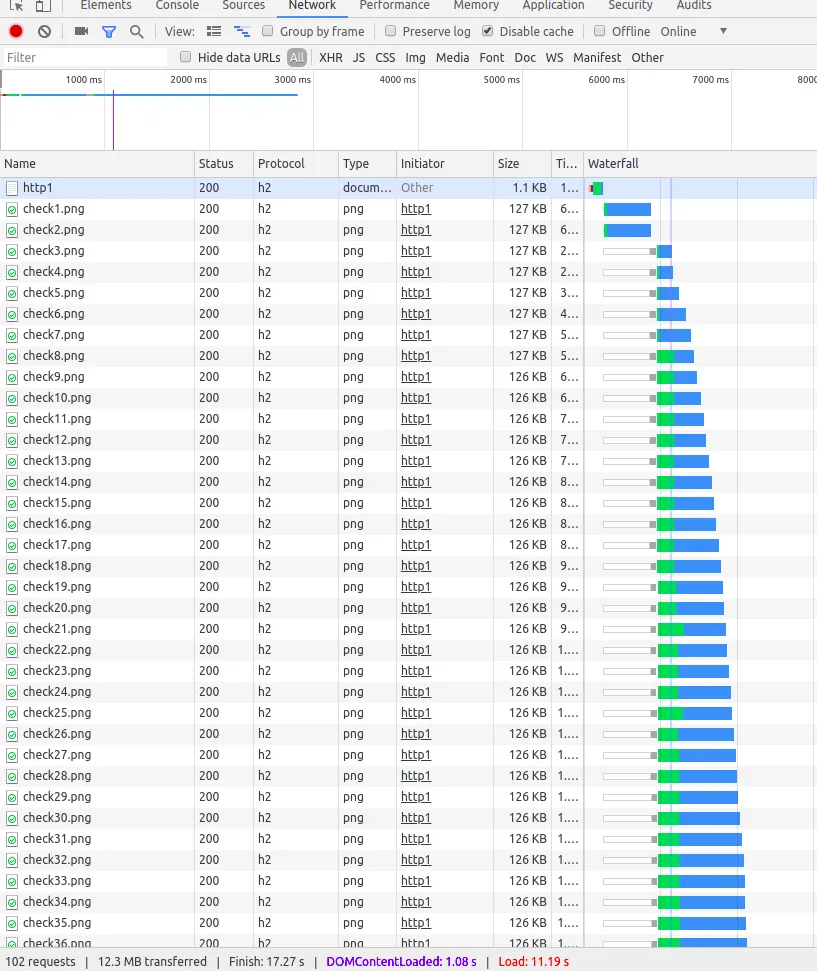
| Http/2 | 102 | 11.19s | Initiator of the first one is user/client and the rest of the requests are initiated by the response to client who realizes he needs some other resources |
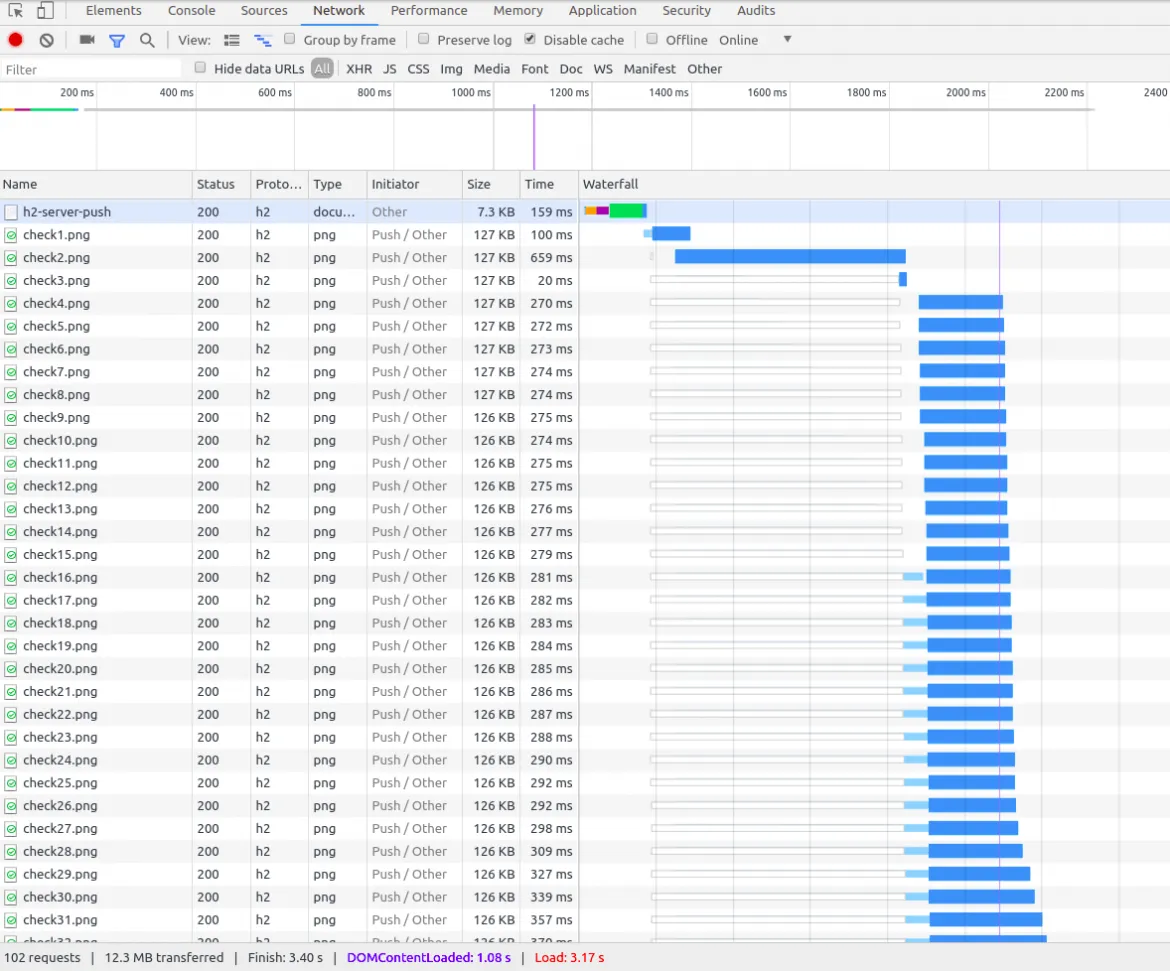
| Http/2 with Server Push | 102 | 3.17s | Initiator of the first one is user/client and the rest of requests are initiated by the push of the server (virtually one request/response cycle). |
- Http/1.1: 102 requests, 12.97s load time
We can see how requests are made through multiple batches (TCP connections).
- Http/2: 102 requests, 11.19s load time
We can see how requests are made through 2 batches (TCP connections). Take note of the load time. In this case, it is a bit lower than the load time of HTTP/1.1 example (but it doesn’t have to be always). This example shows the multiplexing of client requests.
- Http/2 with Server Push: 102 requests, 3.17s load time
We can see how requests are made through 1 batch (1 TCP connection).

- Animation demonstration
References
- rfc1945: Hypertext Transfer Protocol — HTTP/1.0
- rfc2616: Hypertext Transfer Protocol — HTTP/1.1
- rfc7230: Hypertext Transfer Protocol (HTTP/1.1): Message Syntax and Routing
- rfc7231: Hypertext Transfer Protocol (HTTP/1.1): Semantics and Content
- rfc7232: Hypertext Transfer Protocol (HTTP/1.1): Conditional Requests
- rfc7233: Hypertext Transfer Protocol (HTTP/1.1): Range Requests
- rfc7234: Hypertext Transfer Protocol (HTTP/1.1): Caching
- rfc7235: Hypertext Transfer Protocol (HTTP/1.1): Authentication
- rfc7540: Hypertext Transfer Protocol Version 2 (HTTP/2)
- rfc9114: HTTP/3
- Evolution of HTTP | MDN